
| Publisher | Verve Books |
|---|---|
| Date Published | 04 December 2018 |
| ISBN-13 | 978-0857308009 |
| Format | paperback |
| Pages | 350 |
| Price | £ 9.99 |
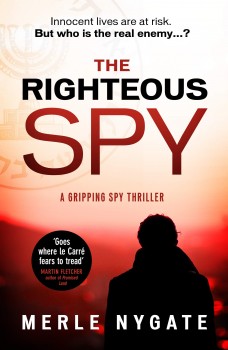
The Righteous Spy
by
The Israeli Intelligence Services know that MI6 has information they need and devise an intricate plot to persuade them to part with it. It involves a young woman from Gaza, but what part, precisely, is she going to play?
Review
The book begins with a brief – half a page – chapter, set in the present day, in which an unknown 27-year-old is describing the reaction of Abu Muhunnad as they were saying prayers together. He seemed to be holding back tears – something that puzzles his companion, who is more than grateful to do something that will make a difference.
The first thing to say about this novel is that it is extremely well-plotted and full of suspense. In some ways it is not an easy read but that is because the nature of its subject – espionage – is in itself complex. In fact, in this particular book it is more than usually so. Among national intelligence services Mossad is known for its no-nonsense approach and its determination to get the job done at all costs.
Here, for once, the job does not appear to involve any violence and is simply concerned with getting MI6 to part with information that is vital to Israel. The intention is to achieve this by persuading MI6 – and through them the British Government – that Israel has done it a considerable favour. The way in which this is to be achieved is highly complex and requires the reader's full attention.
Any plot, however gripping, depends on its characters and those in this novel are portrayed very carefully and realistically. There are three main ones – Eli and Rafi, who devise the details of the scenario to be presented to MI6 – and Petra, recruited by them to play an important role. The first two, whilst managing to work together more or less harmoniously, are very different and each in his own way very convincing.
Eli appears to be a spy with a conscience, perhaps the ‘righteous spy’ of the title. He is always aware that, whilst the job he is doing is justifiable, there is sometimes a price to be paid, perhaps by innocent parties – something he is determined to avoid whenever possible. However, human nature being what it is, he is also aware that the post of Head of London Station, for which he has a certain understandable ambition, is vacant.
Rafi, on the other hand, is a man totally convinced that the ends justify the means, one who will not hesitate to recommend the swift removal of all obstacles in their way, regardless of the morality of any such actions. Petra, whilst fully prepared to carry out the role assigned to her, cannot help showing her femininity as she gets to know and to care for the young woman in her charge, particularly since she knows what lies ahead for her.
Perhaps what makes the novel such an interesting one is the question that runs all the way through it. How can anyone believe that the deliberate killing of a large number of people in a terrorist attack can be regarded as a morally defensible act and the perpetrator as a martyr? Whilst the novel is by no means a philosophical tract, this question becomes more and more central as it progresses.
There are some spy novels that ignore the essential cynicism of espionage and which emphasise the heroic or the romantic aspect of the profession. This is certainly not one of those. I could never be sure how it was to end but I was made aware that even the best-laid plans can go wrong.
The first thing to say about this novel is that it is extremely well-plotted and full of suspense. In some ways it is not an easy read but that is because the nature of its subject – espionage – is in itself complex. In fact, in this particular book it is more than usually so. Among national intelligence services Mossad is known for its no-nonsense approach and its determination to get the job done at all costs.
Here, for once, the job does not appear to involve any violence and is simply concerned with getting MI6 to part with information that is vital to Israel. The intention is to achieve this by persuading MI6 – and through them the British Government – that Israel has done it a considerable favour. The way in which this is to be achieved is highly complex and requires the reader's full attention.
Any plot, however gripping, depends on its characters and those in this novel are portrayed very carefully and realistically. There are three main ones – Eli and Rafi, who devise the details of the scenario to be presented to MI6 – and Petra, recruited by them to play an important role. The first two, whilst managing to work together more or less harmoniously, are very different and each in his own way very convincing.
Eli appears to be a spy with a conscience, perhaps the ‘righteous spy’ of the title. He is always aware that, whilst the job he is doing is justifiable, there is sometimes a price to be paid, perhaps by innocent parties – something he is determined to avoid whenever possible. However, human nature being what it is, he is also aware that the post of Head of London Station, for which he has a certain understandable ambition, is vacant.
Rafi, on the other hand, is a man totally convinced that the ends justify the means, one who will not hesitate to recommend the swift removal of all obstacles in their way, regardless of the morality of any such actions. Petra, whilst fully prepared to carry out the role assigned to her, cannot help showing her femininity as she gets to know and to care for the young woman in her charge, particularly since she knows what lies ahead for her.
Perhaps what makes the novel such an interesting one is the question that runs all the way through it. How can anyone believe that the deliberate killing of a large number of people in a terrorist attack can be regarded as a morally defensible act and the perpetrator as a martyr? Whilst the novel is by no means a philosophical tract, this question becomes more and more central as it progresses.
There are some spy novels that ignore the essential cynicism of espionage and which emphasise the heroic or the romantic aspect of the profession. This is certainly not one of those. I could never be sure how it was to end but I was made aware that even the best-laid plans can go wrong.
Reviewed 27 April 2019 by Arnold Taylor


