
| Publisher | Doubleday |
|---|---|
| Date Published | 26 July 2019 |
| ISBN-13 | 978-0857524720 |
| Format | hardcover |
| Pages | 400 |
| Price | £ 16.99 |
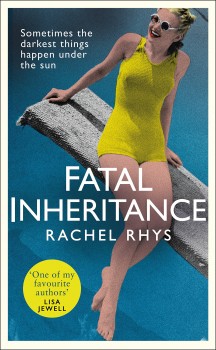
Fatal Inheritance
by
Eve Forrester feels herself ensnared in a loveless marriage. She sees no way out of it and is resigned to living in a gloomy house, with no friends to brighten her existence. A letter from a firm of solicitors brings unexpected changes.
Review
Eve Forrester is sitting alone watching two raindrops travelling down a pane of glass and making a bet on which will get to the bottom first. She ought to be outside fetching in her washing, but she cannot summon up the energy to do even that. She is unutterably bored and is looking forward to her daily treat of Mrs Dale's Diary. Her husband Clifford will be home in a few hours but she knows better than to expect any comfort from his return. He enjoys his 'little bit of quiet' and will, as usual, just sit and read his newspaper without speaking to her.
Not that she minds particularly, because whenever he does speak it is only to correct her and to suggest how she should do whatever it is that she is doing wrong. She would find it impossible to say why she married this man, why she opted for such an uneventful existence. All she knows is that she did and has now to live with the consequences. She might be more hopeful if she had a meaningful relationship with her mother, but for perfectly understandable reasons she has never been able to feel much love for her.
She doesn't realise, as she sits there, that her life is just about to undergo a complete change. A letter, which she originally assumed was from her uncaring mother, turns out instead to be from a firm of solicitors in London, informing her that she has been named as a beneficiary in the will of a certain Guy Lester. She will need, however, to travel to Cannes to find out precisely what her bequest is. Although she has never heard the name Guy Lester, she decides to undertake the journey, regarding it as at least an adventure – something of which she is desperately in need.
The author manages to convey very effectively the sudden sense of freedom that Eve feels aboard the luxurious Blue Train from the Gare de Lyon. The fact that Clifford has left her to make the journey alone make her even happier. She still cannot imagine who her benefactor might be but she becomes more and more excited the closer she gets to Cannes. Eventually she finds out from Guy Lester's solicitors that she has been left a quarter share in a very expensive Riviera property.
There is, however, a problem. The remaining three-quarters have been left to Mr Lester's wife Dian and his two sons Noel and Duncan, none of whom can see how somebody who appears to be a complete outsider comes to deserve a quarter share. It is this antagonism that makes up one of the two dominant themes of the novel, the other being the relationship (if any) that had caused Lester to leave such a bequest to Eve Forrester.
Since he was known to have had numerous love affairs, the general view amongst the other heirs is that she must be a hitherto unknown love child. The complex answer, which is withheld until nearly the end of the novel, is entirely convincing when it does arrive. Dian in particular can hardly manage to speak a civil word to her, not only because on account of the will, but she is also a total snob – in spite of having come from nothing herself – and regards Eve as socially inferior.
Fatal Inheritance is not, however, merely a mystery story. There’s a significant and pleasing change in the character of the heroine. Downtrodden and subject to her husband's whims at the beginning of the book, she gradually begins to assert herself and to show that she is by no means an easy prey to the financial machinations of others. Nor is she the only person of interest. There is plenty of opportunity in the Riviera setting for social gatherings of the wealthy and spoilt and we meet a number of characters, all of whom are well drawn. One of them – an American novelist – seems to have been introduced merely to provide romantic interest, but even he is interesting in himself.
The ending provides an answer to one of the questions that puzzle the reader. Why does Eve have such a bad – one might almost say poisonous – relationship with her mother? It is possible – and the author clearly intended that it should be – to see the answer to this puzzle before it is finally disclosed. That demands, however, a very attentive reading of a book that is thoroughly worthy of it.
Not that she minds particularly, because whenever he does speak it is only to correct her and to suggest how she should do whatever it is that she is doing wrong. She would find it impossible to say why she married this man, why she opted for such an uneventful existence. All she knows is that she did and has now to live with the consequences. She might be more hopeful if she had a meaningful relationship with her mother, but for perfectly understandable reasons she has never been able to feel much love for her.
She doesn't realise, as she sits there, that her life is just about to undergo a complete change. A letter, which she originally assumed was from her uncaring mother, turns out instead to be from a firm of solicitors in London, informing her that she has been named as a beneficiary in the will of a certain Guy Lester. She will need, however, to travel to Cannes to find out precisely what her bequest is. Although she has never heard the name Guy Lester, she decides to undertake the journey, regarding it as at least an adventure – something of which she is desperately in need.
The author manages to convey very effectively the sudden sense of freedom that Eve feels aboard the luxurious Blue Train from the Gare de Lyon. The fact that Clifford has left her to make the journey alone make her even happier. She still cannot imagine who her benefactor might be but she becomes more and more excited the closer she gets to Cannes. Eventually she finds out from Guy Lester's solicitors that she has been left a quarter share in a very expensive Riviera property.
There is, however, a problem. The remaining three-quarters have been left to Mr Lester's wife Dian and his two sons Noel and Duncan, none of whom can see how somebody who appears to be a complete outsider comes to deserve a quarter share. It is this antagonism that makes up one of the two dominant themes of the novel, the other being the relationship (if any) that had caused Lester to leave such a bequest to Eve Forrester.
Since he was known to have had numerous love affairs, the general view amongst the other heirs is that she must be a hitherto unknown love child. The complex answer, which is withheld until nearly the end of the novel, is entirely convincing when it does arrive. Dian in particular can hardly manage to speak a civil word to her, not only because on account of the will, but she is also a total snob – in spite of having come from nothing herself – and regards Eve as socially inferior.
Fatal Inheritance is not, however, merely a mystery story. There’s a significant and pleasing change in the character of the heroine. Downtrodden and subject to her husband's whims at the beginning of the book, she gradually begins to assert herself and to show that she is by no means an easy prey to the financial machinations of others. Nor is she the only person of interest. There is plenty of opportunity in the Riviera setting for social gatherings of the wealthy and spoilt and we meet a number of characters, all of whom are well drawn. One of them – an American novelist – seems to have been introduced merely to provide romantic interest, but even he is interesting in himself.
The ending provides an answer to one of the questions that puzzle the reader. Why does Eve have such a bad – one might almost say poisonous – relationship with her mother? It is possible – and the author clearly intended that it should be – to see the answer to this puzzle before it is finally disclosed. That demands, however, a very attentive reading of a book that is thoroughly worthy of it.
Reviewed 23 February 2019 by Arnold Taylor


