
| Publisher | Endeavour |
|---|---|
| Date Published | 18 June 2018 |
| ISBN-10 | 1911445618 |
| ISBN-13 | 978-1911445616 |
| Format | paperback |
| Pages | 320 |
| Price | £ 7.99 |
The Dead on Leave
by
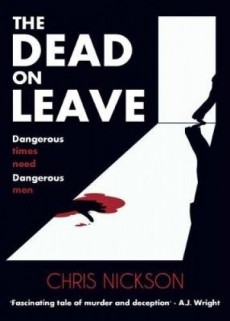
A march by Mosley and his Blackshirts is held in Leeds. There is considerable violence throughout the march and when it is over the body of a man is discovered. He has been strangled.
Review
It is 1936 and Great Britain is still in the grip of recession. The city of Leeds, once such a centre of industrial production, seems almost to have come to a halt. Many of the wool mills, which provided jobs, have been closed down. Men who had been unemployed for years, and who see no hope of a job in the immediate future, stand in groups on street corners, defeated and penniless. There is a feeling that, whilst the depression affects the whole country, it is particularly evident in the heavily industrialised north. Southerners might be interested in the Prince of Wales, Mrs Simpson and the future of the throne but in this dirty, grey and tired city such speculation is mainly absent. They simply don’t care.
The author does a very good job in portraying the hopelessness that many people felt and in putting the historical situation before our eyes. The signs carrying advertisements for Bisto, Bile Beans and Mazawatee Tea are made of cardboard but at least they introduce some colour into the down-at-heel city. The men's clothes are shirts without collars and trousers shiny with age and use.
In a detective story, however, no matter how realistic and historically accurate, the plot remains all-important and initially it seems to be well constructed. At the end of the fascist march, when the crowds have dispersed, the body of a man is found in an alleyway. It is not long before it is identified as Frank Benson who had worked in that most hated of all occupations – a means test assessor. As such he had a big say in whether an impoverished family should receive a grant. Having been unemployed for a year, he was determined to hold on to the new position and carried out his duties very enthusiastically, making himself universally unpopular in the process. Not surprisingly, he had numerous enemies, any one of whom was quite likely to have killed him.
The investigation begins efficiently enough but then the police appear to run out of ideas. Detective Sergeant Urban Raven is in charge of the day-to-day running of the case, but in view of the possible political implications, both his inspector and superintendent keep a close watch on his progress.
The trouble comes when the normal areas of investigation – family, acquaintances, employers – are exhausted and little or no progress has been made. It is then that Raven receives a tip-off that opens up another line of enquiry. If this were an isolated incident it would be unremarkable but, as the investigation continues, he receives more and more help of this nature. More and more characters make an entry, some of them providing further information for Raven, until it seems that all he has to do is wait for the case to solve itself. Almost inevitably, one of the leads eventually turns out to be precisely what Raven needs to solve the case – or, if not exactly solve it, at least make an arrest.
One of the people interviewed, the daughter of the murdered man, seems to have an unusually large part in the novel considering that she has little to contribute. We find the same kind of irrelevance in the frequent references to Raven's marriage, which appears to be going off the rails. In addition, the kind of detail that was welcome at the beginning of the novel to provide a realistic setting tends to be repeated throughout until the reader becomes rather tired of hearing what Leeds looked like in 1936. Overall, it has to be said that the book seems, particularly in its second half, to meander along with no real plan.
The author does a very good job in portraying the hopelessness that many people felt and in putting the historical situation before our eyes. The signs carrying advertisements for Bisto, Bile Beans and Mazawatee Tea are made of cardboard but at least they introduce some colour into the down-at-heel city. The men's clothes are shirts without collars and trousers shiny with age and use.
In a detective story, however, no matter how realistic and historically accurate, the plot remains all-important and initially it seems to be well constructed. At the end of the fascist march, when the crowds have dispersed, the body of a man is found in an alleyway. It is not long before it is identified as Frank Benson who had worked in that most hated of all occupations – a means test assessor. As such he had a big say in whether an impoverished family should receive a grant. Having been unemployed for a year, he was determined to hold on to the new position and carried out his duties very enthusiastically, making himself universally unpopular in the process. Not surprisingly, he had numerous enemies, any one of whom was quite likely to have killed him.
The investigation begins efficiently enough but then the police appear to run out of ideas. Detective Sergeant Urban Raven is in charge of the day-to-day running of the case, but in view of the possible political implications, both his inspector and superintendent keep a close watch on his progress.
The trouble comes when the normal areas of investigation – family, acquaintances, employers – are exhausted and little or no progress has been made. It is then that Raven receives a tip-off that opens up another line of enquiry. If this were an isolated incident it would be unremarkable but, as the investigation continues, he receives more and more help of this nature. More and more characters make an entry, some of them providing further information for Raven, until it seems that all he has to do is wait for the case to solve itself. Almost inevitably, one of the leads eventually turns out to be precisely what Raven needs to solve the case – or, if not exactly solve it, at least make an arrest.
One of the people interviewed, the daughter of the murdered man, seems to have an unusually large part in the novel considering that she has little to contribute. We find the same kind of irrelevance in the frequent references to Raven's marriage, which appears to be going off the rails. In addition, the kind of detail that was welcome at the beginning of the novel to provide a realistic setting tends to be repeated throughout until the reader becomes rather tired of hearing what Leeds looked like in 1936. Overall, it has to be said that the book seems, particularly in its second half, to meander along with no real plan.
Reviewed 26 January 2019 by Arnold Taylor


