
| Publisher | Penguin Random House Children's |
|---|---|
| Date Published | 19 October 2017 |
| ISBN-10 | 0385604416 |
| ISBN-13 | 978-0385604413 |
| Format | hardcover |
| Pages | 560 |
| Price | £ 20.00 |
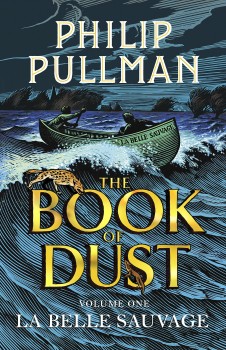
The Book of Dust: La Belle Sauvage
by
Life is pleasant and uneventful for Malcolm Polstead until, by chance, he becomes embroiled in a power struggle between the competing worlds of religion, politics and academic study. He also becomes inextricably linked to a baby called Lyra.
Review
The news that a new book in Philip Pullman’s His Dark Materials series was being produced was good news to very many of us. Fortunately, the Book of Dust: La Belle Sauvage delivers on every level.
Malcolm Polstead is a first-class new protagonist. His character, his moods and his naivety, coupled with his natural wit, are described by Pullman with his characteristic skill. Overlay this with the fact that familiar places and characters appear, that the context of actions is explained and that the origin of characters is made clear. But we already know much of this world and it is like stepping back into a new adventure in familiar territory. I couldn’t put The Book of Dust down, and when I finished it I immediately re-read the first three books.
Malcolm, the son of the owners of the Trout, a pub on the side of the Thames in Oxford. is about the same age in this book as Lyra was in the Northern Lights. The fact that he falls for the baby Lyra is charming and also sets the imagination running to know how this relationship will develop in the next parts of this new trilogy. The Magisterium is every bit as sinister and intrusive at this point of history as when it intrudes upon the life of Lyra. The League of St Alexander is a chilling addition with resonances of Nazi Youth or the cold war Eastern Bloc.
The drama of the journey in La Belle Sauvage is relentless and exhausting, as well as graphic and believable. La Belle Sauvage, Malcolm’s boat, becomes a character in its own right, made even more attractive by the intervention of Lord Asriel.
So much happens that the difficulty in talking about it is to avoid any spoilers. Read it. If you loved the first ones you will love this. Nothing beats the feeling of being embraced by a world populated by people with whom you are familiar, others of whom you want to know more and new characters plus the potential of further interesting plots in the future.
Malcolm Polstead is a first-class new protagonist. His character, his moods and his naivety, coupled with his natural wit, are described by Pullman with his characteristic skill. Overlay this with the fact that familiar places and characters appear, that the context of actions is explained and that the origin of characters is made clear. But we already know much of this world and it is like stepping back into a new adventure in familiar territory. I couldn’t put The Book of Dust down, and when I finished it I immediately re-read the first three books.
Malcolm, the son of the owners of the Trout, a pub on the side of the Thames in Oxford. is about the same age in this book as Lyra was in the Northern Lights. The fact that he falls for the baby Lyra is charming and also sets the imagination running to know how this relationship will develop in the next parts of this new trilogy. The Magisterium is every bit as sinister and intrusive at this point of history as when it intrudes upon the life of Lyra. The League of St Alexander is a chilling addition with resonances of Nazi Youth or the cold war Eastern Bloc.
The drama of the journey in La Belle Sauvage is relentless and exhausting, as well as graphic and believable. La Belle Sauvage, Malcolm’s boat, becomes a character in its own right, made even more attractive by the intervention of Lord Asriel.
So much happens that the difficulty in talking about it is to avoid any spoilers. Read it. If you loved the first ones you will love this. Nothing beats the feeling of being embraced by a world populated by people with whom you are familiar, others of whom you want to know more and new characters plus the potential of further interesting plots in the future.
Reviewed 17 February 2018 by John Barnbrook


