
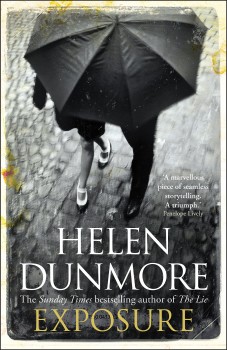
| Publisher | Hutchinson |
|---|---|
| Date Published | 28 January 2016 |
| ISBN-10 | 0091953944 |
| ISBN-13 | 978-0091953942 |
| Format | hardcover |
| Pages | 400 |
| Price | £ 16.99 |
Exposure
by
It’s 1960 London, and Cold War paranoia is at its height – so someone is going to have to shoulder the blame for a top-secret file going missing.
Review
You know when you get a book which is so engrossing that you read it at a snail’s pace to make it last, purr over every page and then can’t put it out of your mind when you’ve eventually finished it … Exposure is one of those rare treats.
It’s very much a slow-burner and almost incidentally a thriller. And when you get to the end, you realise how little has actually happened. But it doesn’t matter a jot, given the quality of Helen Dunmore’s writing and the way she ensnares you in her beautifully-constructed web. This is a writer who truly understands that less is more.
A bare bones summary simply won’t do the book justice. It’s set in London in the winter of 1960 with the Callington family at the heart of the story. Bear in mind that the Cold War is at its height, and paranoia off the top of the scale. So when a top-secret file goes AWOL, someone is going to have to take the blame. And it’s Simon Carrington who is accused of passing information to the Russians and is arrested.
Simon and the rather seedy spook Giles Holloway have past history which means Simon gets dragged into the unfortunate chain of events against his will. But it’s his wife Lily and their three young children – Paul, Sally and Bridget – who seize centre stage and stay there. And it’s rare that I feel as invested in characters as I did with those four. Talk about rooting for them to survive and resenting every moment when the story moves away from them!
Dunmore’s prose is almost cinematic (I frequently imagined the narrative in black and white like a film), always elegant and silky-smooth; the fact she writes in the present tense, not a favourite technique of mine, barely registered. She has 1960s London unfolding to perfection, from the government offices to the young families in the suburbs. And when the action moves away from the city, I had the setting etched vividly in my mind – particularly when it comes to a scene late on which had me squeaking out loud!
One key angle – and certainly one that might have frightened the horses – is glossed over at the end. But if I may borrow Dunmore’s train metaphor, which echoes through the book, it in no way spoils what is a truly first-class journey.
It’s very much a slow-burner and almost incidentally a thriller. And when you get to the end, you realise how little has actually happened. But it doesn’t matter a jot, given the quality of Helen Dunmore’s writing and the way she ensnares you in her beautifully-constructed web. This is a writer who truly understands that less is more.
A bare bones summary simply won’t do the book justice. It’s set in London in the winter of 1960 with the Callington family at the heart of the story. Bear in mind that the Cold War is at its height, and paranoia off the top of the scale. So when a top-secret file goes AWOL, someone is going to have to take the blame. And it’s Simon Carrington who is accused of passing information to the Russians and is arrested.
Simon and the rather seedy spook Giles Holloway have past history which means Simon gets dragged into the unfortunate chain of events against his will. But it’s his wife Lily and their three young children – Paul, Sally and Bridget – who seize centre stage and stay there. And it’s rare that I feel as invested in characters as I did with those four. Talk about rooting for them to survive and resenting every moment when the story moves away from them!
Dunmore’s prose is almost cinematic (I frequently imagined the narrative in black and white like a film), always elegant and silky-smooth; the fact she writes in the present tense, not a favourite technique of mine, barely registered. She has 1960s London unfolding to perfection, from the government offices to the young families in the suburbs. And when the action moves away from the city, I had the setting etched vividly in my mind – particularly when it comes to a scene late on which had me squeaking out loud!
One key angle – and certainly one that might have frightened the horses – is glossed over at the end. But if I may borrow Dunmore’s train metaphor, which echoes through the book, it in no way spoils what is a truly first-class journey.
Reviewed 13 February 2016 by Sharon Wheeler


