
| Publisher | Viper |
|---|---|
| Date Published | 01 February 2023 |
| ISBN-10 | 1788165969 |
| ISBN-13 | 978-1788165969 |
| Format | paperback |
| Pages | 400 |
| Price | £ 9.99 |
Blue Water
by
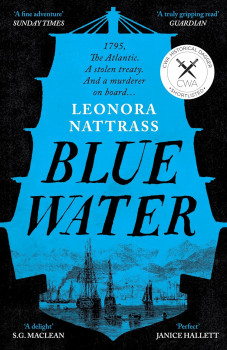
An important political treaty is being carried on the packet ship Tankerville to America for signing. Some of the passengers are on board in order to protect it. Others have very different agendas.
Review
An important political treaty is being taken to America for signing in the care of the son of a United States envoy. Also on board the packet ship Tankerville is Lawrence Jago, a disgraced foreign office clerk, who is charged with ensuring the safety of the treaty, and a War Office official, Frederick Jenkinson, similarly charged. The other passengers are either French or American. There’s also a dog, and sometime later they are joined by an Irish woman with a bear.
Lawrence’s constant worry about the treaty is evident as he tries to do a good job to get back into the good books of Lord Grenville, the British Foreign Secretary, to whom he is sending secret reports. As cover, Lawrence is supposed to be going to work with the newspaper journalist, Philpott, whom he is supposed to be assisting and who knows all about his supposedly seedy past and current mission.
The novel illustrates very clearly the precariousness of life at sea at the end of the 18th century. For example, when the water barrels are empty, there is no way that a voyage can continue, there being no means on board to collect and store enough water for passengers and crew. If an enemy chases the boat and is faster, then there is little that can be done to escape. If something damages the rigging the heavy wooden spars can then fall on unsuspecting people on deck, with lethal consequences.
In addition, the book describes the cramped conditions below deck where hammocks are slung with almost no room for personal belongings, where the few cabins are tiny and completely without light, and where even the mess room has to convert into an operating theatre if someone is injured.
The length of time in such conditions clearly can interfere with people’s mental health, and this appears to be the case with Lawrence who, when the treaty disappears, spends his time constructing theory after theory about what might have happened. As there are fewer than ten passengers and only a few named crew, this leaves very few possible conversations by which to test the theories. Fortunately, there is a very handy list of characters at the start of the book which is particularly helpful in the early chapters. At times, more action would have improved the pace.
The mix of passengers ensures that a number of historical issues are touched upon, including the politics of the time between England, France and America; the growing profession of journalism; changing attitudes to slavery and the deeply-felt resentment of slaves themselves; competition between countries in the production of fabric, with the advent of faster industrial machinery; tensions for aristocratic families in revolutionary France; and changing attitudes to women and of young women’s expectations of life.
Life aboard the ship is wonderfully described and the basic and claustrophobic nature of daily living on such a long voyage comes through very clearly.
Lawrence’s constant worry about the treaty is evident as he tries to do a good job to get back into the good books of Lord Grenville, the British Foreign Secretary, to whom he is sending secret reports. As cover, Lawrence is supposed to be going to work with the newspaper journalist, Philpott, whom he is supposed to be assisting and who knows all about his supposedly seedy past and current mission.
The novel illustrates very clearly the precariousness of life at sea at the end of the 18th century. For example, when the water barrels are empty, there is no way that a voyage can continue, there being no means on board to collect and store enough water for passengers and crew. If an enemy chases the boat and is faster, then there is little that can be done to escape. If something damages the rigging the heavy wooden spars can then fall on unsuspecting people on deck, with lethal consequences.
In addition, the book describes the cramped conditions below deck where hammocks are slung with almost no room for personal belongings, where the few cabins are tiny and completely without light, and where even the mess room has to convert into an operating theatre if someone is injured.
The length of time in such conditions clearly can interfere with people’s mental health, and this appears to be the case with Lawrence who, when the treaty disappears, spends his time constructing theory after theory about what might have happened. As there are fewer than ten passengers and only a few named crew, this leaves very few possible conversations by which to test the theories. Fortunately, there is a very handy list of characters at the start of the book which is particularly helpful in the early chapters. At times, more action would have improved the pace.
The mix of passengers ensures that a number of historical issues are touched upon, including the politics of the time between England, France and America; the growing profession of journalism; changing attitudes to slavery and the deeply-felt resentment of slaves themselves; competition between countries in the production of fabric, with the advent of faster industrial machinery; tensions for aristocratic families in revolutionary France; and changing attitudes to women and of young women’s expectations of life.
Life aboard the ship is wonderfully described and the basic and claustrophobic nature of daily living on such a long voyage comes through very clearly.
Reviewed 25 March 2024 by Sylvia Maughan


