
| Publisher | Applause Books |
|---|---|
| Date Published | 15 June 2022 |
| ISBN-10 | 1493063251 |
| ISBN-13 | 978-1493063253 |
| Format | hardcover |
| Pages | 320 |
| Price | £ 36.00 |
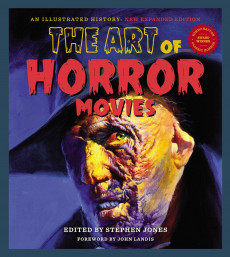
The Art of Horror Movies
by
The expanded second edition of An Illustrated History: The Art of Horror Movies provides a visual tour of movie history through informative, engaging text, copious film posters and other advertising material
Review
The expanded second edition of An Illustrated History: The Art of Horror Movies edited by Stephen Jones provides a superbly sumptuous tour of horror films from the earliest days of cinema in the 19th century to the current millennium via eras succinctly described in such alliterative titles such as The Sinister Silents, The Thrilling Thirties, all the way up to The Nasty Nineties and beyond.
An informative forward on The Iconography of Horror by John Landis starts, quite reasonably, by stating what Basil Fawlty might refer to as the bleedin’ obvious: the art of film advertising is to get the paying public through the cinema doors. This often involves a somewhat loose relationship between the movie and the advertising poster and in other cases this relationship seems to have ended in an acrimonious divorce, with the poster bearing no relation at all to its original source material.
However, providing the poster has got bums on seats, that’s all the matters – unless you’re the punter who thought that the bizarrely cute cross between a spaniel and an oversized dachshund on the 1983 poster for director Lewis Teague’s version of Cujo made the film suitable for your five-year-old.
Some of the earliest movies in the latter part of the 19th century had beautifully coloured and lettered posters such as those for four French films produced at a time when brothers Auguste and Louis Lumière were pioneering the Cinematograph, whilst on the other side of the Atlantic Thomas A Edison was working on bringing photography to life with his Kinetoscope process. Every section in the book taught me many things I didn’t know, and I became fascinated by the various ways found to bring moving pictures to rapt audiences.
When I was growing up, I managed to traumatise myself by watching films like The Innocents and The Signalman, so I tended to stay away from anything billed as horror. But even I didn’t leave the room when actors like the talented Lon Chaney came on screen, contorting his face and body in shocking parodies of disability intended to evoke sympathy as well as horror, as without that human connection and empathy there is often nothing left for the audience apart from the voyeurism typified by the so-called freak shows. The posters for many of Chaney’s films depict sinister figures in top hats with staring eyes and a degree of dental exaggeration, drawing audiences in with the promise of shocks and shivers.
Some of my childhood favourites were films like The Lost World, which featured unfortunate lizards dressed up as prehistoric creatures, and I loved the page of posters from early dinosaur films from the 1918 litho three-sheet poster for Willis H O’Brien’s The Ghosts of Slumber Mountain. This was the first film to show live actors on screen with stop motion dinosaurs, including a triceratops locked in mortal combat with a T.rex. There is also an American trade advert for the 1925 version of Arthur Conan Doyle’s adventure classic with a huge sauropod stomping on London’s Tower Bridge. Naturally, the later Godzilla and King Kong films also make an appearance in the book.
Fast forward to The Evil Eighties, the time of the video nasty, with public figures such as Margaret Thatcher pronouncing that outright bans were needed in place of voluntary regulation when films with titles such as Toxic Zombies, retitled for the UK as Forest of Fear, quickly found themselves on the naughty step. The posters were usually garish and very, very unsubtle, with bloodstained knives and rotting bodies clawing their way out of the earth.
Posters from the Nasty Nineties vary wildly from the darkly sinister to startlingly colourful, with highlights for me being the poster for Stephen Sommers’s iconic 1999 reboot of The Mummy that shows a screaming face in the clouds above the pyramids in a glorious composition formed of gold and shadows.
I was absolutely fascinated by the erudite and engaging text that accompanied each section, allowing me to learn more about the history of cinema of each film era, while I happily yelled ‘Seen it!’ at many of the films illustrated in this large, gorgeous and beautifully produced book. For horror fans this is an absolutely must, and for anyone who would like to know more about a genre that has amply demonstrated its enduring fascination among worldwide audiences, this is a book that can be read from cover to cover, or simply dipped into as the fancy takes you.
An informative forward on The Iconography of Horror by John Landis starts, quite reasonably, by stating what Basil Fawlty might refer to as the bleedin’ obvious: the art of film advertising is to get the paying public through the cinema doors. This often involves a somewhat loose relationship between the movie and the advertising poster and in other cases this relationship seems to have ended in an acrimonious divorce, with the poster bearing no relation at all to its original source material.
However, providing the poster has got bums on seats, that’s all the matters – unless you’re the punter who thought that the bizarrely cute cross between a spaniel and an oversized dachshund on the 1983 poster for director Lewis Teague’s version of Cujo made the film suitable for your five-year-old.
Some of the earliest movies in the latter part of the 19th century had beautifully coloured and lettered posters such as those for four French films produced at a time when brothers Auguste and Louis Lumière were pioneering the Cinematograph, whilst on the other side of the Atlantic Thomas A Edison was working on bringing photography to life with his Kinetoscope process. Every section in the book taught me many things I didn’t know, and I became fascinated by the various ways found to bring moving pictures to rapt audiences.
When I was growing up, I managed to traumatise myself by watching films like The Innocents and The Signalman, so I tended to stay away from anything billed as horror. But even I didn’t leave the room when actors like the talented Lon Chaney came on screen, contorting his face and body in shocking parodies of disability intended to evoke sympathy as well as horror, as without that human connection and empathy there is often nothing left for the audience apart from the voyeurism typified by the so-called freak shows. The posters for many of Chaney’s films depict sinister figures in top hats with staring eyes and a degree of dental exaggeration, drawing audiences in with the promise of shocks and shivers.
Some of my childhood favourites were films like The Lost World, which featured unfortunate lizards dressed up as prehistoric creatures, and I loved the page of posters from early dinosaur films from the 1918 litho three-sheet poster for Willis H O’Brien’s The Ghosts of Slumber Mountain. This was the first film to show live actors on screen with stop motion dinosaurs, including a triceratops locked in mortal combat with a T.rex. There is also an American trade advert for the 1925 version of Arthur Conan Doyle’s adventure classic with a huge sauropod stomping on London’s Tower Bridge. Naturally, the later Godzilla and King Kong films also make an appearance in the book.
Fast forward to The Evil Eighties, the time of the video nasty, with public figures such as Margaret Thatcher pronouncing that outright bans were needed in place of voluntary regulation when films with titles such as Toxic Zombies, retitled for the UK as Forest of Fear, quickly found themselves on the naughty step. The posters were usually garish and very, very unsubtle, with bloodstained knives and rotting bodies clawing their way out of the earth.
Posters from the Nasty Nineties vary wildly from the darkly sinister to startlingly colourful, with highlights for me being the poster for Stephen Sommers’s iconic 1999 reboot of The Mummy that shows a screaming face in the clouds above the pyramids in a glorious composition formed of gold and shadows.
I was absolutely fascinated by the erudite and engaging text that accompanied each section, allowing me to learn more about the history of cinema of each film era, while I happily yelled ‘Seen it!’ at many of the films illustrated in this large, gorgeous and beautifully produced book. For horror fans this is an absolutely must, and for anyone who would like to know more about a genre that has amply demonstrated its enduring fascination among worldwide audiences, this is a book that can be read from cover to cover, or simply dipped into as the fancy takes you.
Reviewed 25 March 2024 by Linda Wilson


