
| Publisher | Abacus |
|---|---|
| Date Published | 25 April 2023 |
| ISBN-10 | 034914575X |
| ISBN-13 | 978-0349145754 |
| Format | hardcover |
| Pages | 320 |
| Price | £ 20.00 |
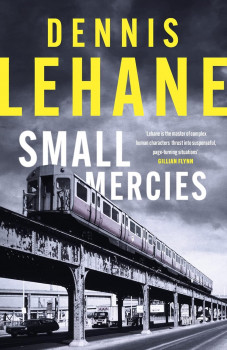
Small Mercies
by
When teenager Jules Fennessy fails to return home, her mother Mary Pat goes looking for her. And one way or another, she will have answers.
Review
Dennis Lehane is the writer of numerous crime best-sellers, a number of which have made decent films. The Boston Irish-American community is the focus of several, as is the case with his latest, although the protagonist is unusual in that it is a woman, living in a male-dominated 1974 world.
Mary Pat Fennessy is what is known as a tough broad, brought up in Southie, one of Boston’s unforgiving working-class neighbourhoods, who after the death of one husband and the departure of another was left to bring up two children unaided. With her son lost to drugs, her daughter Jules is the one remaining good thing in her life.
So when Jules never reappears after a night out, Mary Pat immediately starts to dread the worst. She will not rest, however, until she has found out exactly what happened, even when local crime boss Marty Butler makes it clear that her questions are giving rise to very unwelcome police attention, and persistence will be severely punished.
Jules’ fate turns out to be linked to a death on the night she went missing, that of a black youth, Auggie Williamson, found on the train tracks of a station in a white neighbourhood. As it turns out, Auggie was the son of Calliope, a woman with whom Mary Pat works. The pair have much in common, but colour imposes a divide that effectively makes it impossible for them ever to share a friendship beyond the superficial.
The background to the death lies in the history of malice between adjoining black and white inner-city districts, currently running hot after a court decision confirming bussing of students between schools to mix blacks and whites. Neither community is happy with the decision, pushed by activists, but the whites are particularly aggrieved, seeing this as just the latest of a series of measures which deprive them of the freedom to live by their own laws.
As Mary Pat pushes for answers, the tensions in the community are revealed through personal exchanges, many violent. In Southie, loyalty to family and tribe take precedence over everything else, but Mary Pat’s breaking of ranks shows the belief in shared values held by her neighbours to be little more than cosy assumptions.
As with Lehane’s previous work, the story is carried forward primarily through dialogue, direct and convincing. Coupled with the use of the present tense, this gives an immediacy which takes the reader directly into the heart of the tale. Mary Pat, facing any parents’ worst nightmare, refuses to give way to her grief and, with nothing more to lose, looks for retribution on those who took the one good thing in her life from her. Small Mercies is a powerful tale, told with Lehane’s usual skill.
Mary Pat Fennessy is what is known as a tough broad, brought up in Southie, one of Boston’s unforgiving working-class neighbourhoods, who after the death of one husband and the departure of another was left to bring up two children unaided. With her son lost to drugs, her daughter Jules is the one remaining good thing in her life.
So when Jules never reappears after a night out, Mary Pat immediately starts to dread the worst. She will not rest, however, until she has found out exactly what happened, even when local crime boss Marty Butler makes it clear that her questions are giving rise to very unwelcome police attention, and persistence will be severely punished.
Jules’ fate turns out to be linked to a death on the night she went missing, that of a black youth, Auggie Williamson, found on the train tracks of a station in a white neighbourhood. As it turns out, Auggie was the son of Calliope, a woman with whom Mary Pat works. The pair have much in common, but colour imposes a divide that effectively makes it impossible for them ever to share a friendship beyond the superficial.
The background to the death lies in the history of malice between adjoining black and white inner-city districts, currently running hot after a court decision confirming bussing of students between schools to mix blacks and whites. Neither community is happy with the decision, pushed by activists, but the whites are particularly aggrieved, seeing this as just the latest of a series of measures which deprive them of the freedom to live by their own laws.
As Mary Pat pushes for answers, the tensions in the community are revealed through personal exchanges, many violent. In Southie, loyalty to family and tribe take precedence over everything else, but Mary Pat’s breaking of ranks shows the belief in shared values held by her neighbours to be little more than cosy assumptions.
As with Lehane’s previous work, the story is carried forward primarily through dialogue, direct and convincing. Coupled with the use of the present tense, this gives an immediacy which takes the reader directly into the heart of the tale. Mary Pat, facing any parents’ worst nightmare, refuses to give way to her grief and, with nothing more to lose, looks for retribution on those who took the one good thing in her life from her. Small Mercies is a powerful tale, told with Lehane’s usual skill.
Reviewed 21 January 2024 by Chris Roberts


